Parkinson's Progression ML帕金森病进展 ML
An EDA + statistics + machine-learning study on a 500-patient Parkinson's dataset — Random Forest, linear regression and a neural network (MLP), compared honestly. The headline finding: the available clinical features are only weakly predictive of progression. A 6-person group project; I was notebook integrator and summary writer.基于 500 病人帕金森数据集的 EDA + 统计 + 机器学习研究——随机森林、线性回归与神经网络(MLP)的诚实对比。核心结论:现有临床特征对进展只有弱预测力。6 人组项目;我担任 notebook 整合与总结撰写。
Try the predictor above — it runs a linear model fitted on the real 500-patient dataset, in your browser. Move the sliders and watch what happens (or rather, what doesn't).试试上方的预测器——它在浏览器里运行一个拟合于真实 500 病人数据的线性模型。拖动滑块,看会发生什么(或者说,看什么都没发生)。
01The question & data问题与数据
Can routine clinical measurements — age, years-since-diagnosis, UPDRS score, tremor, motor function, speech, balance, medication and exercise — predict how a patient's Parkinson's disease is progressing? We treated it as an honest data-science problem across 500 patients.常规临床测量——年龄、确诊年数、UPDRS 评分、震颤、运动功能、言语、平衡、用药与锻炼——能否预测帕金森病的进展?我们把它当作 500 病人上的一个诚实数据科学问题。
02Exploration & statistics探索与统计
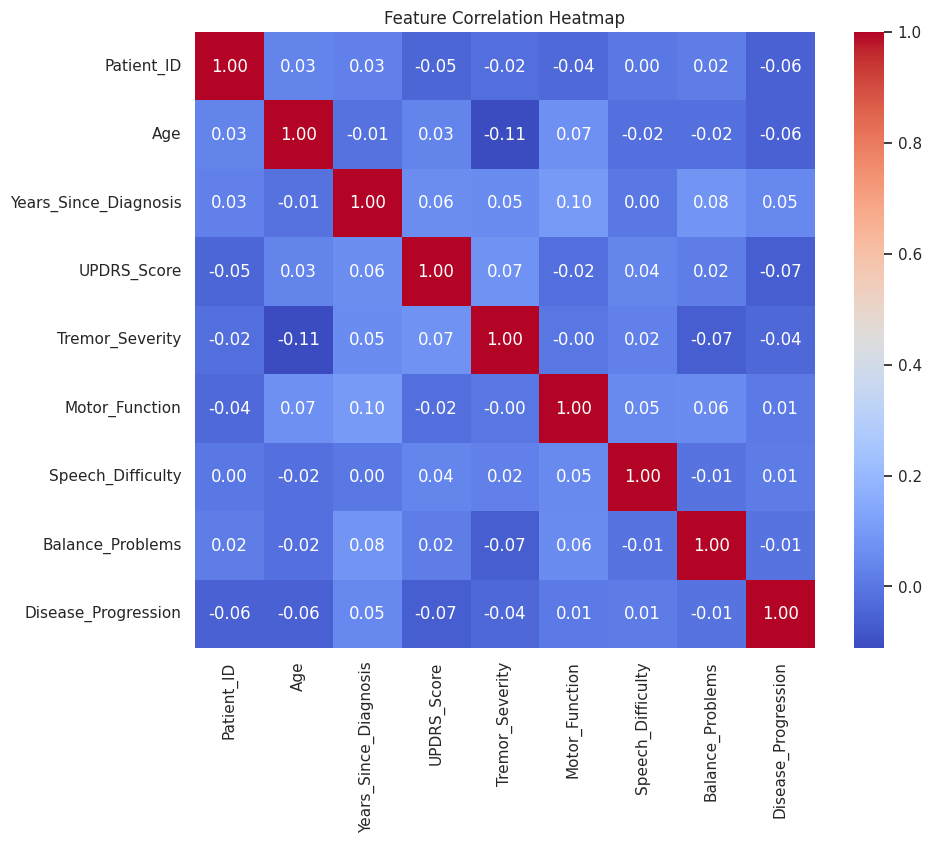
- UPDRS score stays fairly flat across years-since-diagnosis, with mild rises at years 3 and 7 — progression is not cleanly linear.UPDRS 评分在确诊年数上基本平稳,第 3、7 年略升——进展并非干净的线性。
- A one-way ANOVA on UPDRS by medication group was not significant (F = 1.12, p = 0.34): medication type alone does not explain severity.按用药分组对 UPDRS 做单因素 ANOVA 不显著(F = 1.12,p = 0.34):用药类型本身不解释病情严重度。
- Higher exercise level associated with mildly lower UPDRS — suggestive, but with overlapping spread.锻炼水平越高 UPDRS 略低——有提示性,但分布重叠。
03Machine-learning attempts机器学习尝试
- High-risk classifier (UPDRS > 40), Random Forest: accuracy 0.48, F1 0.38, AUC 0.61 — it under-predicts risk and is barely better than guessing.高危分类器(UPDRS > 40),随机森林:准确率 0.48,F1 0.38,AUC 0.61——低估风险,仅略好于瞎猜。
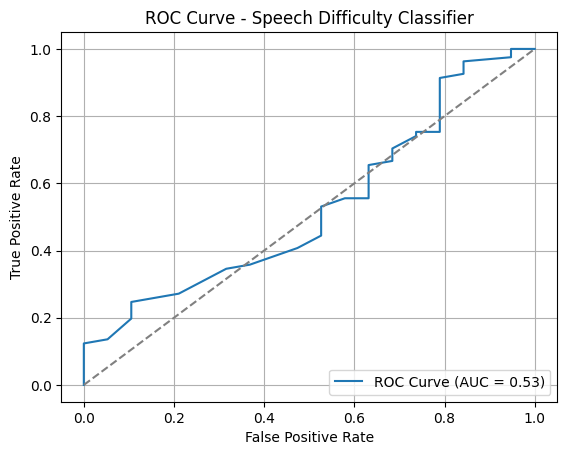
- Speech-difficulty classifier: 82% accuracy looks good, but it is a class-imbalance artifact — the model predicts 'has difficulty' almost always (recall 0.05 for the negative class, AUC 0.53 ≈ random). The high score is misleading, not skill.言语障碍分类器:82% 准确率看着好,但这是类别不平衡的假象——模型几乎总预测「有障碍」(负类召回 0.05,AUC 0.53≈随机)。高分是误导,不是能力。
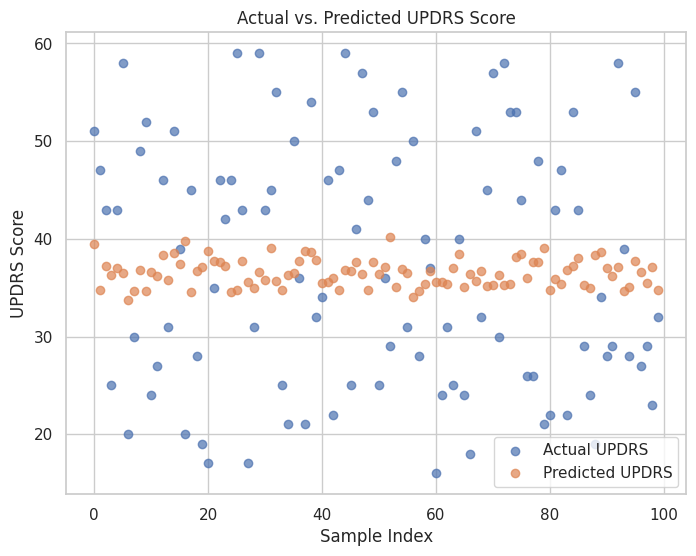
- Linear regression of UPDRS: predicts close to the dataset mean for everyone (in-sample R² ≈ 0.02) — exactly what the live predictor above shows.UPDRS 线性回归:对所有人都预测接近数据集均值(样本内 R² ≈ 0.02)——正是上方预测器所展示的。
- Neural network (MLP) benchmark: I also trained a multilayer-perceptron neural network (8→32→16, ReLU / Adam) and put it head-to-head with the Random Forest and linear model on a held-out test set — none beat a naive predict-the-mean baseline (AUC ≈ 0.50, negative R²), confirming the signal isn't in these features.神经网络(MLP)基线:我还训练了一个多层感知机神经网络(8→32→16,ReLU / Adam),在留出测试集上与随机森林、线性模型正面对比——都没能超过「预测均值」的朴素基线(AUC ≈ 0.50,R² 为负),证实信号不在这些特征里。
04The honest finding诚实的结论
The real result is a negative one: on this dataset, demographic and symptom features alone cannot reliably predict progression, and an accuracy number can hide that (the 82% speech model). Saying so clearly — instead of cherry-picking the flattering metric — is the actual takeaway, and what richer clinical inputs would need to fix.真正的结果是个否定结论:在这份数据上,仅靠人口学与症状特征无法可靠预测进展,而一个准确率数字可能把这掩盖(那个 82% 的言语模型)。把这点说清楚——而不是挑那个好看的指标——才是真正的收获,也是更丰富的临床输入需要去解决的。
05My role我的角色
In a six-person team I was a notebook integrator and summary writer — compiling the Colab notebook, formatting the outputs, and drafting the insights and reflections that turned a pile of analyses into a coherent, honest report.在 6 人组里,我担任 notebook 整合与总结撰写——汇编 Colab notebook、整理输出,并撰写把一堆分析变成连贯、诚实报告的洞察与反思。
3D-Printer Hotend Retrofit3D 打印机热端改装
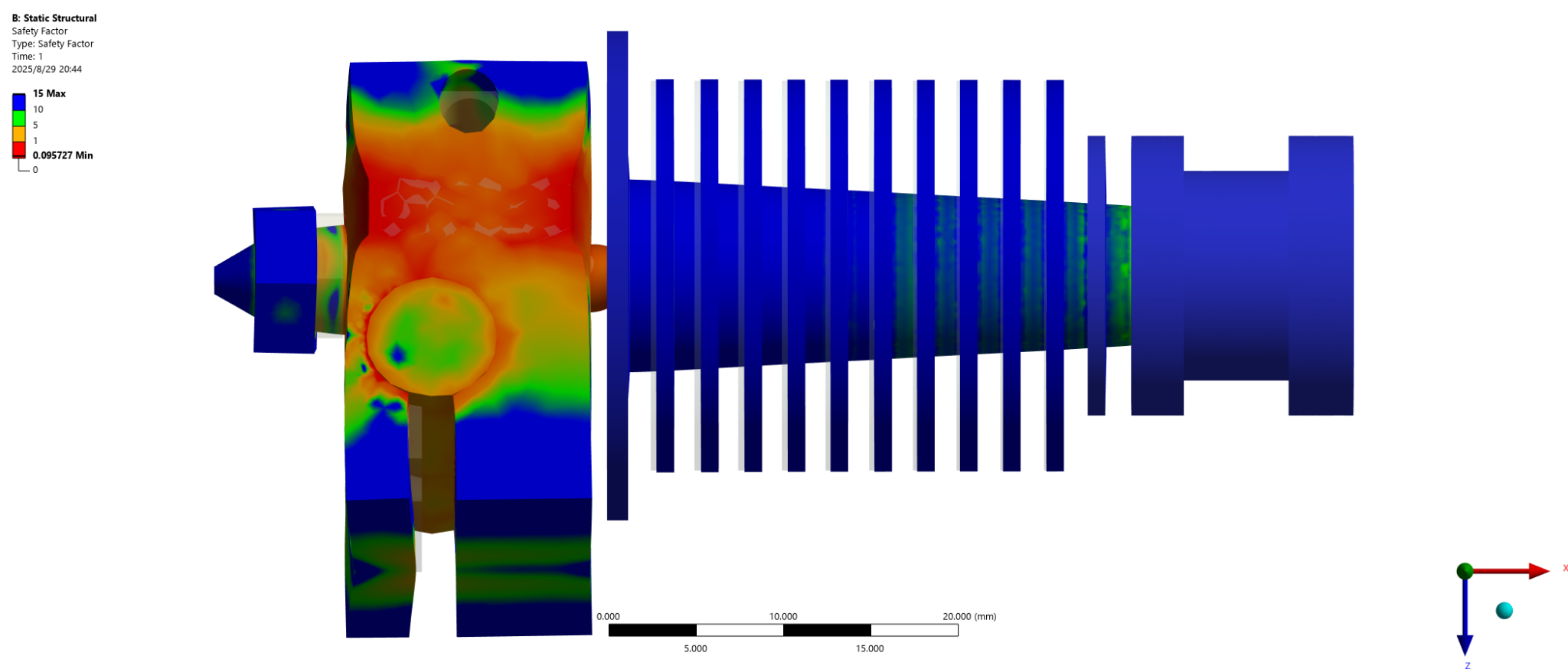
An ENG5105 client project for ForgeFab: redesign a 3D-printer hotend so a batch of mistakenly-bought Prusa MK4 nozzles can run on the older ENG5105 客户项目(ForgeFab):重设计 3D 打印机热端,让误购的一批 Prusa MK4 喷嘴能用在较旧的 MK3 S+ 平